Vishvarupa
Bhagavad GitaVishvarupa is the supreme sovereign form revealed by Krishna to Arjuna at the turning point of their dialogue on the battlefield of Kurukshetra. It is not merely an enlarged image of a deity but a total vision in which gods, creatures, worlds, time, energy, creation, and destruction appear gathered into one immeasurable body. The revelation breaks through Arjuna’s delusion while also forcing him to confront the terrifying meaning of the battle: the warriors before him are already caught within a destruction that exceeds his individual agency, and his task is to become its instrument.
Request and Preparation
Arjuna asks to behold Vishvarupa only after Krishna’s teaching has begun to dispel his confusion. He says that the discourse on the supreme mystery has benefited him and that he has heard Krishna explain the creation and dissolution of beings, as well as his imperishable greatness. Arjuna accepts that Krishna’s account of himself is true, yet intellectual assent is not enough. He desires direct vision of Krishna’s sovereign form and submits the request conditionally, asking Krishna to show it if he is competent to behold it.
Krishna answers by defining the vision as an excess of ordinary perception. He promises to reveal forms by hundreds and thousands, varied in divine color and shape, including the Adityas, Vasus, Rudras, Ashvins, and Maruts. The entire universe of moving and unmoving things will be present within him, but Arjuna cannot see this reality with his ordinary eye. Krishna therefore grants him celestial sight. Vishvarupa is thus both a revelation and a transformation of the viewer: the form is not simply displayed before Arjuna but made accessible through a divinely enabled mode of seeing.
The Cosmic Body
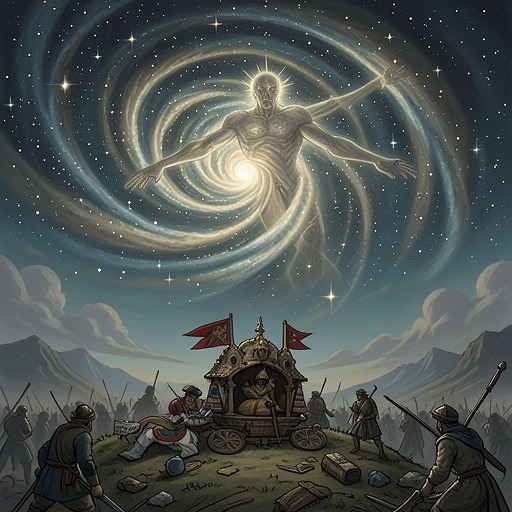
Sanjaya’s narration presents the manifestation as an overwhelming visual event. Krishna appears with many mouths and eyes, innumerable aspects, celestial ornaments, raised weapons, garlands, robes, fragrances, and faces turned in every direction. The form is infinite, radiant, and filled with marvels. Its brilliance is compared to the simultaneous bursting forth of a thousand suns in the sky, an image that makes ordinary measures of light inadequate to the vision.
Within Krishna’s body Arjuna sees the entire universe divided and subdivided into many parts, yet collected together. The form has no observable beginning, middle, or end. It bears a diadem, mace, and discus; its eyes are the Sun and Moon; fire issues from its mouth; its energy heats the universe. The image joins opposites that ordinary perception keeps apart. Vishvarupa is intimate enough to contain every being and immeasurable enough to exceed the horizon of heaven and earth. It is the universe as a unified body, but not a peaceful unity: its innumerable arms, thighs, feet, stomachs, mouths, eyes, and terrible tusks make totality appear as both boundless abundance and terrifying excess.
The vision also gathers divine and semidivine orders into a single field. Arjuna beholds the gods, hosts of creatures, Brahman seated on the lotus, Rishis, celestial snakes, and countless beings associated with the divine world. Rudras, Adityas, Vasus, Siddhas, Viswas, Ashvins, Maruts, Ushmapas, Gandharvas, Yakshas, Asuras, and other hosts witness the form in amazement, fear, or prayer. Their reactions establish that Vishvarupa is not one being among other beings. Even the inhabitants of the sacred and supernatural orders are confronted by a reality greater than their own categories.
Terror and the Meaning of Destruction
The revelation becomes frightening when Arjuna sees the warriors of the battle entering Krishna’s mouths. The sons of Dhritarashtra, the assembled kings, Bhishma, Drona, Karna, and the principal warriors on Arjuna’s side are all drawn rapidly toward the tusked mouths. Some strike against the spaces between the teeth with crushed heads. The battlefield’s opposing divisions, which had appeared as human armies with competing claims, are refigured as streams moving toward the ocean and moths rushing into a blazing fire. Their movement is swift, repeated, and irreversible.
The comparison with water currents emphasizes inevitability, while the image of moths adds the horror of beings rushing toward their own destruction. Krishna swallows the men from every side and licks them with flaming mouths; his splendor fills and heats the universe. Arjuna cannot recognize the directions or recover peace of mind. The form has therefore crossed from wonder into cosmic dread. It does not merely show that death exists. It makes visible a scale of destruction in which individual courage, lineage, martial reputation, and political purpose are absorbed into a process already larger than the combatants’ intentions.
When Arjuna asks who Krishna is in this fierce form and says that he does not understand the action he is witnessing, Krishna identifies himself as Death, the destroyer of worlds, fully developed and engaged in slaying the human race. The declaration changes the status of the battle. The warriors standing in their divisions will cease to be even without Arjuna, and Krishna tells Arjuna to rise, gain glory, defeat the foe, and enjoy the kingdom. Drona, Bhishma, Jayadratha, Karna, and the other heroic warriors have already been slain by Krishna in the cosmic order; Arjuna is instructed to kill them as the instrument of an outcome already determined.
Relation to Krishna’s Teaching
Vishvarupa gathers together doctrines that Krishna has communicated elsewhere in the dialogue. Krishna’s teaching about his imperishable devotional system reaches backward through Vivasvat, Manu, and Ikshaku, and he explains that he takes birth through his own power when piety declines and impiety rises. Vishvarupa gives that claim a visual and universal scale: Krishna is not only a teacher who preserves a lost discipline but the power through which protection, destruction, and the restoration of piety occur age after age.
The form also clarifies Krishna’s teaching about death, rebirth, and the ultimate goal. Krishna explains that beings become manifest between birth and death and return to an unmanifest condition when death comes, while another eternal and indestructible reality lies beyond the cycles of manifestation and dissolution. The cosmic body embodies this rhythm. It contains emergence and disappearance, the visible and the invisible, the changing world and the Supreme presence beyond destruction. Its terrible mouths do not cancel Krishna’s promise of an imperishable supreme seat; they place mortal existence within a larger order in which return, dissolution, and transcendence are distinguished.
The revelation further intensifies the teaching that devotion must redirect every action toward Krishna. Devotees who remember him at the final moment attain his essence, while those who maintain uninterrupted concentration find him easy to approach. Vishvarupa makes such remembrance concrete by presenting Krishna as the encompassing reality toward which all paths, beings, and consequences converge. The form is not an escape from action. It is the ground from which Arjuna must return to action with his understanding transformed.
Consequence for Arjuna
Arjuna’s response combines fear, submission, and renewed recognition. He trembles, folds his hands, bows, and speaks with a voice overwhelmed by the sight. He acknowledges that the universe rightly delights in Krishna’s praise, that Rakshasas flee from him, and that hosts of Siddhas bow before him. He recognizes Krishna as greater than Brahman, the primal cause, the first and ancient Being, the supreme refuge, the knower, the object of knowledge, and the highest abode. He also identifies Krishna with Vayu, Yama, Agni, Varuna, the Moon, Prajapati, and the Grandsire, extending the vision’s claim across the divine order.
The most important consequence is not that Arjuna receives a new command but that he understands the command’s cosmic setting. Earlier, grief had made him see the battle chiefly as the killing of kinsmen and the destruction of family customs. He feared that victory would be empty because those for whom sovereignty and pleasure were desired stood on the field ready to die. Vishvarupa does not erase the violence he feared; instead, it reveals that the destruction is already incorporated into Krishna’s world-encompassing action. Arjuna’s role changes from a man paralyzed before an unbearable moral catastrophe to a warrior who accepts participation in a reality whose consequences surpass personal desire.
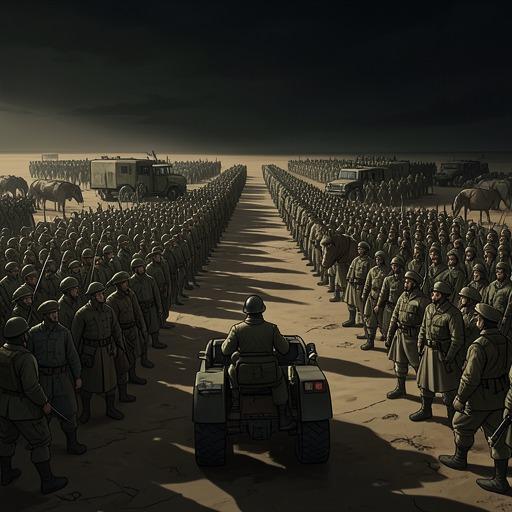
Vishvarupa therefore functions as a decisive threshold in the Krishna–Arjuna Dialogue. The dialogue begins with the armies assembled on the sacred plain of Kurukshetra and Arjuna’s bow falling from his hand. It reaches its most vertiginous point when the battlefield is seen inside the body of the divine, with every army, god, and creature drawn into one form. The vision does not make the war ordinary; it makes ordinary human categories inadequate to it. By revealing both the totality of Krishna and the inevitability of the warriors’ destruction, Vishvarupa converts Arjuna’s grief into a chastened readiness to act.